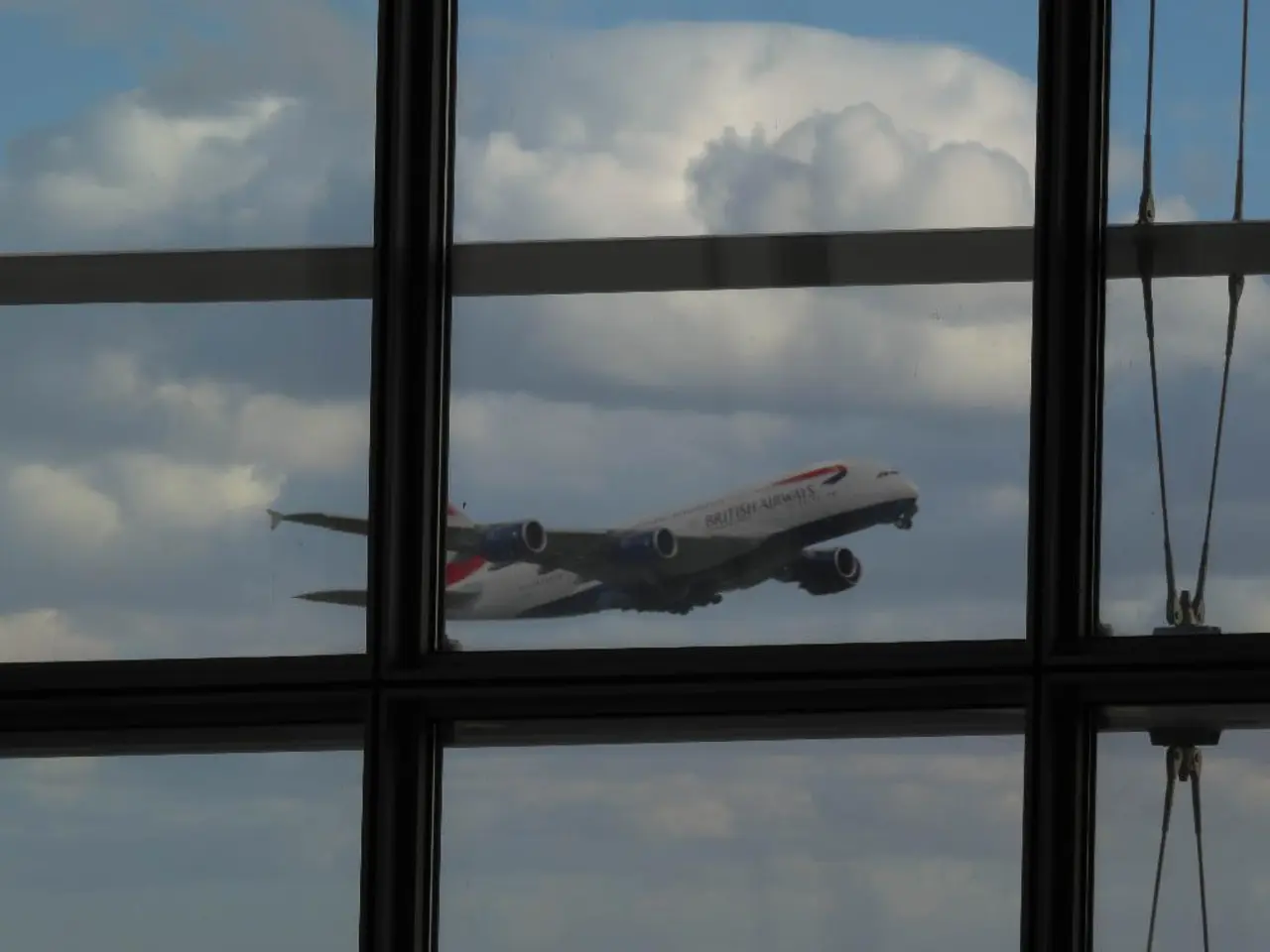
NASA's futuristic X-59 aircraft experiences supersonic airflow in test chamber, captured in space-themed photograph for July 16, 2025
**Breaking News: NASA's X-59 Supersonic Jet Aims to Revolutionise Air Travel**
The X-59, a groundbreaking experimental aircraft developed by Lockheed Martin Skunk Works in California, is set to redefine the future of air travel. Part of NASA's Quiet Supersonic Technology (QueSST) programme, the X-59 is designed to demonstrate and collect data on technologies that reduce sonic boom noise, potentially lifting the ban on supersonic flight over land that has been in place since the Concorde era[1].
The X-59 is not intended to serve as a prototype for a new commercial aircraft, but rather to pave the way for quieter, supersonic air travel. NASA plans to conduct community overflights with the X-59, exposing select cities to its "sonic thump" to gather public feedback and provide regulators with a factual basis for assessing the acceptability of quiet supersonic flight[3].
The aircraft's unique design includes a very long, sharp nose (approximately 38 feet, nearly a third of its total 99.7-foot length), small wings, and a top-mounted engine. The X-59 is designed to cruise at Mach 1.4 (approximately 925–940 mph) at 55,000 feet[1][2][3]. It is powered by a General Electric F414-GE-100 engine, producing 22,000 pounds of thrust, and the engine is mounted on top of the fuselage to help shield ground observers from engine noise and contribute to a "sound shield" effect[1][3]. The cockpit has no forward-facing windows, with pilots relying on external cameras and displays for visibility, eliminating a potential source of shockwave distortion[1].
The X-59's design aims to disrupt and separate shockwaves before they can merge into a single, loud boom. The elongated nose and carefully shaped fuselage are engineered to disperse shockwaves over a longer distance, preventing them from merging and thus reducing the intensity of the sonic boom[1][3]. The design allows shockwaves to remain separate, resulting in a series of weaker pressure waves perceived as a gentle "thump" rather than a disruptive boom. NASA estimates the X-59's noise at about 75 EPNdB, significantly quieter than the 105–110 dB of the Concorde[3].
NASA and Japan's Aerospace Exploration Agency (JAXA) have extensively tested scaled-down models in wind tunnels, including a 19-inch, 1.62% scale model in Japan, to validate computational predictions and better understand shockwave behaviour at cruise speeds[5].
The X-59 is scheduled to make its historic first flight this year, marking a significant step towards quieter, supersonic air travel. Stay tuned for updates on this exciting development.
*Subscribe to our newsletter for updates on rocket launches, skywatching events, and more.* *Visit our website to learn more about the recent build of the X-59 aircraft and other experimental planes.*
[1] NASA. (2021). X-59 Quiet Supersonic Technology. [online] Available at: https://www.nasa.gov/feature/x-59-quiet-supersonic-technology
[2] Lockheed Martin. (2021). X-59 Quiet Supersonic Technology. [online] Available at: https://www.lockheedmartin.com/en-us/products/x-59-quiet-supersonic-technology.html
[3] NASA. (2021). NASA's X-59 Quiet Supersonic Technology Aircraft Takes Shape. [online] Available at: https://www.nasa.gov/feature/nasas-x-59-quiet-supersonic-technology-aircraft-takes-shape
[4] NASA. (2021). NASA and JAXA Wind Tunnel Tests X-59 Model. [online] Available at: https://www.nasa.gov/feature/nasa-and-jaxa-wind-tunnel-tests-x-59-model
[5] NASA. (2021). NASA's X-59 Supersonic Jet Aims to Redefine Air Travel. [online] Available at: https://www.nasa.gov/feature/nasas-x-59-supersonic-jet-aims-to-redefine-air-travel
- The X-59, NASA's experimental aircraft, holds immense potential to revolutionize the history of music and travel, as it aims to quieten the sonic boom noise, thus possibly lifting the ban on supersonic flight over land.
- With its unique design, the X-59 could significantly impact the future of technology, particularly air travel, as it cruises at supersonic speeds with reduced noise levels.
- The X-59's technological advancements in supersonic flight could pave the way for new innovations in space-and-astronomy, as it gathers data on the behavior of shockwaves at high speeds.
- Keeping up with the latest in technology, subscribing to our newsletter would provide updates on the X-59's progress, alongside news on rocket launches, skywatching events, and more.